
01Pick a real minimum
Work out what a departure actually costs to run: guide pay, van, fuel, any entry fees. Your minimum is the number of riders where that departure stops losing money. Write it down for each tour, because a full-day mountain tour and a two-hour town ride won’t have the same number.
02Set a decision deadline
Choose a fixed point before each departure when you decide: go ahead, move, or cancel. Far enough out that guests can rearrange travel; close enough that late bookings still count. For many day tours that’s 48 to 72 hours; for trips people travel to, it may be a week or more.
Rule of thumb
Put the minimum and the deadline in your booking terms, so a cancellation never feels like a surprise.
03Watch the numbers before the deadline
An under-booked departure is easier to save a week out than the night before. Check headcount at fixed points, a week, three days and a day before your deadline, and nudge sales while there’s still time.
04Give guests a real choice
- Go ahead anyway, if the departure is close and the group is keen.
- Move everyone to another date for free.
- Cancel and refund in full, without making the guest ask.
A five-minute check
Does every tour have a written minimum?
Is there a fixed decision deadline before each departure?
Are guests told about both before they book?
Do you check headcount before the deadline, not on it?
Is moving everyone to another date one action, not a dozen messages?
How RideLoop handles it
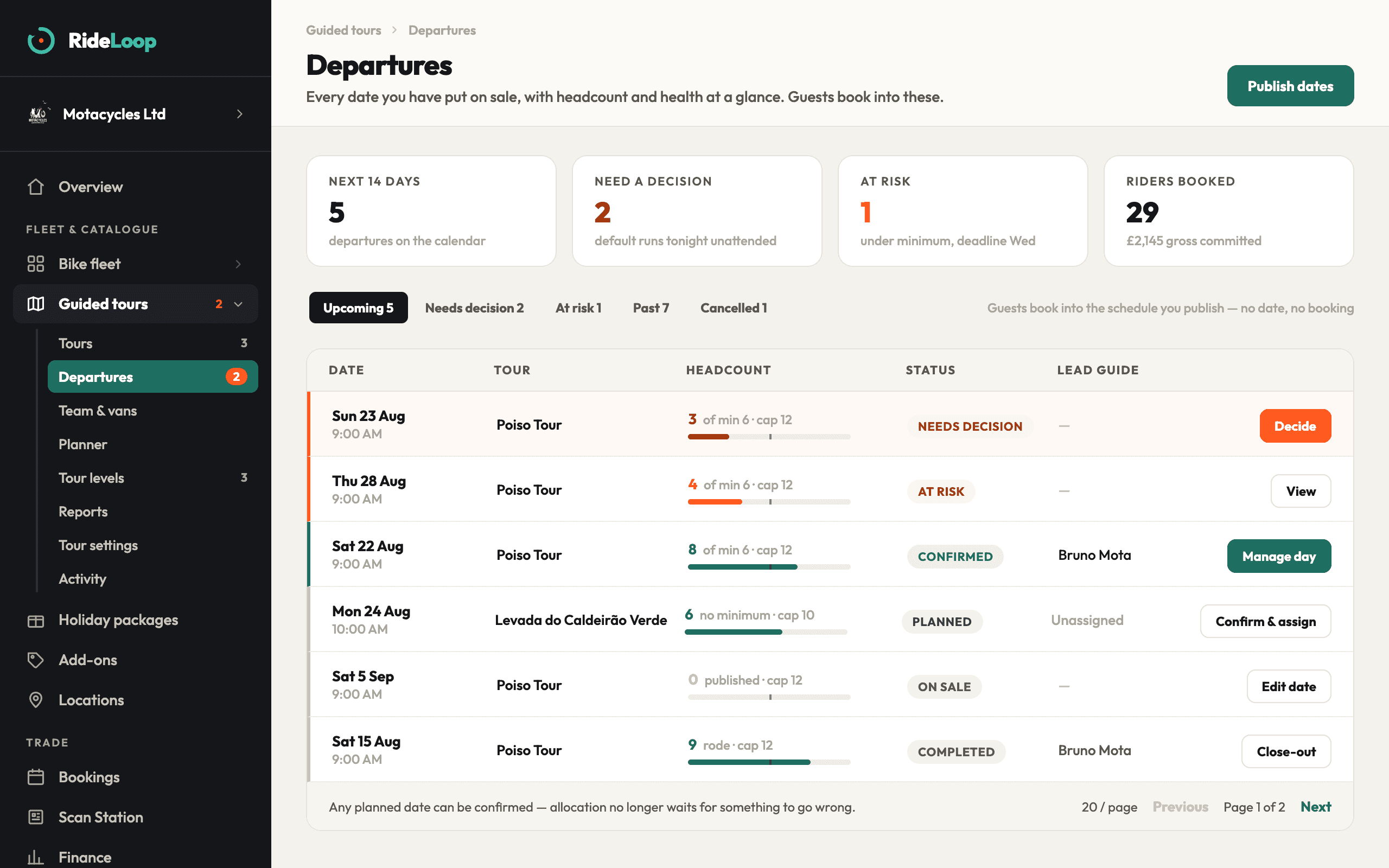
Each RideLoop tour carries a minimum headcount and a decision deadline. Departures create themselves when the first booking lands, and you’re alerted 7 days, 3 days and 24 hours before the deadline. Then you choose: proceed, reschedule everyone for free, or cancel and refund. If you don’t decide, the action you set in advance is applied.
See how tours work →
Bruno Mota
Founder and CEO, Motacycles Ltd
Bruno runs Motacycles, a bike shop and workshop, and builds RideLoop on the same counter. More about the team